


In Memoriam - Gloria Steinem and Dolly Parton
Gloria Steinem died on 2nd September 2026; Dolly Parton died on 25th August 2026 – both amazing and strong women in their own right.
Both standing up for female empowerment through their different areas of influence. We acknowledge their well lived lives.
GLORIA STEINEM
She died in her own home in New York City on Wednesday, September 2, 2026. She was 92 years old. And in the space of one lifetime, she rewrote what it legally meant to be a woman in America.
Start with 1971, the year before everything changed. An American woman could not walk into a bank and open an account in her own name without complications. She could not apply for a credit card without a husband's signature co-signing the application, as if she were a minor rather than an adult citizen. If a boss cornered her in an office or a supervisor demanded favors for a promotion, there was no law to invoke, because the words "sexual harassment" had not yet been written into any statute. The behavior existed everywhere. The legal language to name it, and to fight it, simply did not.
That was the world Gloria Steinem set out to dismantle. Not with speeches alone, but with institutions, laws, and a magazine that mainstream publishers said would never survive its first year.
In 1972, Steinem co-founded Ms. magazine, the first national American publication built, owned, and run entirely by women. Newsstand executives who reviewed the concept predicted it would fold within weeks. The preview issue printed 300,000 copies. It sold out in eight days. Before the month was over, the fledgling magazine had collected 26,000 subscription orders from readers who had never been offered a magazine quite like it before.
Steinem used that new platform for stories no one else would print. In the spring of 1972, Ms. published a petition called "We Have Had Abortions." Fifty-three prominent American women signed their real names beneath it, publicly admitting to a procedure that was, in most of the country, still a crime. They did it under their own names, months before the Supreme Court would even hear arguments in Roe v. Wade. It was one of the first times American women had collectively broken the public silence around abortion in print, not as a hypothetical or a debate, but as something that had already happened to them.
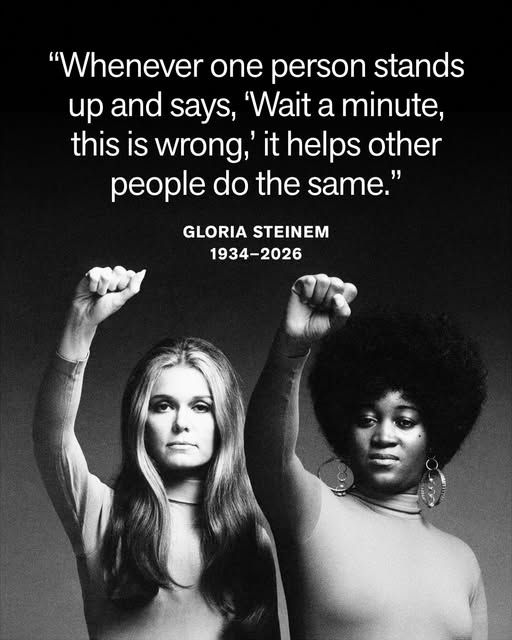
She didn't build any of this alone, and never pretended to. Steinem organized across racial lines at a time when the mainstream feminist movement was frequently and fairly criticized for overlooking Black women entirely. She partnered publicly with Dorothy Pitman Hughes, sharing speaking stages with her for years specifically because a white woman and a Black woman standing together made a point neither could make alone. She co-founded the National Women's Political Caucus alongside Florynce Kennedy and Shirley Chisholm, and insisted, in interviews and speeches, that a movement for equality which left out race wasn't a movement for women at all. It was a movement for some women.
Then she took the fight to Washington. Steinem was among the activists who spent years pushing lawmakers toward what became the Equal Credit Opportunity Act of 1974, the law that finally made it illegal for a bank to require a woman to have a husband, father, or any male relative co-sign before she could get a credit card, a car loan, or a mortgage in her own name. Before 1974, that requirement wasn't an obscure rule buried in fine print somewhere. It was standard banking practice, coast to coast, applied to every adult woman regardless of her income or her credit history.
Here is what most people miss: none of this was inevitable, and none of it happened quickly. Steinem didn't publish one magazine issue and watch the law change the following year. The credit act took years of testimony and lobbying after Ms. launched. The abortion petition ran roughly nine months before Roe v. Wade was even decided, with no guarantee the Court would rule her way, and no way of knowing whether the fifty-three women who signed it would face professional or legal consequences for doing so. Steinem was building toward outcomes she could not see coming, on a timeline she did not control, using tools that look almost quaint by modern standards: a magazine subscription list, a printed petition, a coalition of women who agreed to disagree constantly about tactics but kept showing up anyway. The slowness is the part that tends to get erased in the retelling. It wasn't a single moment. It was roughly fifty years of unglamorous, incremental work that most of the country wasn't paying attention to while it happened.
There is a second layer to that, too, and it is the part that makes her story land differently now than it would have a decade ago. Steinem lived long enough to watch parts of what she helped build get legally unwound. In 2022, the U.S. Supreme Court's decision in Dobbs v. Jackson Women's Health Organization overturned Roe v. Wade, returning abortion policy to individual states rather than treating it as a nationwide constitutional protection. In the years that followed, numerous state legislatures passed new restrictions on reproductive healthcare, and some school districts and libraries removed books tied to the history she helped write. She watched a constitutional protection that had stood for nearly fifty years get reversed within her own lifetime, decades after she first fought to establish the conditions that made it possible.
But here is the distinction that mattered most, in the end. A court can overturn a legal precedent. A school board can pull a book off a shelf. A legislature can rewrite a statute. None of those bodies can force an already-working woman to forget how to apply for her own line of credit. None of them can make an office suddenly nameless again, where an employee facing harassment has no word for what happened to her and no law to point to when she reports it. The credit histories already exist. The subscription lists already exist. An entire generation of women who grew up assuming they could open a bank account in their own name already exists, and there is no legislature on earth that can retroactively un-teach that assumption to more than 160 million American women.
Steinem herself never described any of this as finished business. She said, more than once, that a movement doesn't succeed by winning an argument. It succeeds when the thing it fought for becomes so ordinary that the next generation has to be told it was ever in question at all. That may be the strangest part of her legacy: most American women under 40 have never lived a single day requiring a man's signature to open a bank account, and plenty of them have no idea that fact was ever seriously in dispute. That gap, between the world Steinem was born into in 1934 and the one she died in, at 92, on a Wednesday, in the same city where she built a magazine no one thought would survive its first year, is the real measurement of the life she spent.
Some people spend a lifetime asking for a seat at the table. She spent hers making sure the table itself could no longer stand without one.
______________________________________________________________________
Dolly Parton, the “Queen of Country" singing icon with a personality as bold as her signature blond coif and rhinestone-encrusted outfits, died at 80 years of age.
Parton had been battling cancer before her death, her representatives confirmed on Aug. 25. In a statement announcing the previously undisclosed diagnosis, her representatives reflected on the country icon's legacy and shared details about her final days:
"Our beloved Dolly Parton spent her life and career bringing joy, laughter, hope and integrity into everything she touched. Her unmatched generosity reached the lives of countless people whom she would never meet, yet she was always there to offer a helping hand. Whether it be the hundreds of millions of books donated through her invaluable Imagination Library or funding research that helped create a lifesaving vaccine used around the world, Dolly's unconditional love for all people was the guiding force for her lasting impact. After bravely facing a brief battle with cancer, Dolly departed her Earthly life today at the Vanderbilt-Ingram Cancer Center surrounded by loved ones."
A Heart as Big as Her Voice
Dolly’s philanthropy has always been deeply personal to her. She always believed that when you are in a position to help, you should, and much of her giving has been rooted in the people and places closest to her heart, including East Tennessee and Nashville. For decades, Dolly used her voice, resources and influence to uplift others, inspire millions of children and support causes that hold special meaning to her. Over time, that spirit of generosity has become as much a part of her legacy as the music that made her legendary.
Nine to Five – song and movie around 1980
Dolly and her women colleagues in an office confront a male chauvinist boss – a true challenge to women’s empowerment and equal pay.